- Client
- CCNS, roadside assistance, Lebanon
- Role
- Sole engineer, from scoping to production
- Stack
- NestJS, Prisma, PostgreSQL, React
- Data migrated
- ~900,000 customers, 1M operations
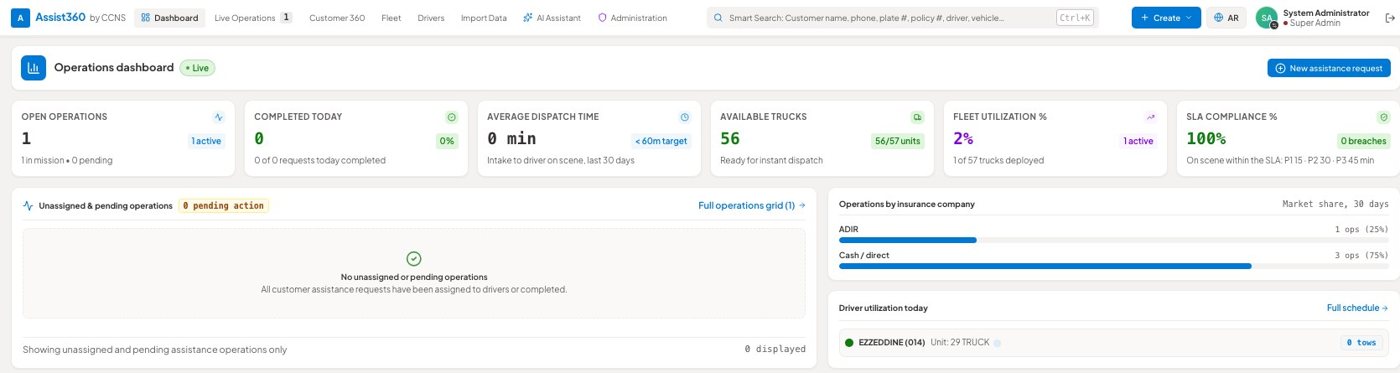
The problem
A roadside assistance company lives on the phone. Every call must find the customer, their insurance policy, their vehicle and the history within seconds, then send the right tow truck and keep the insurer informed. The old software needed copy-pasting across five screens, and nobody knew where an operation stood without calling the driver.
What I built
- A real-time dispatch console at high density: twenty-five operations on screen without scrolling, a detail panel opening under the grid, colours per driver and priority, instant updates for the whole team.
- A Customer 360: one search across name, phone, plate or policy, tolerant to typos and Arabic transliterations, with the full history.
- 3CX telephony: every call journaled, and the customer card opening on the dispatcher’s screen before they pick up.
- WhatsApp Business: messages sent from the company number, a driver’s reply moving the job to “en route”, a customer’s shared location filling in the address.
- Tow-truck GPS: position and estimated arrival, automatic “on scene” on arrival, a public tracking page for the end customer.
- Insurance policy imports from the insurers’ files, with validation and history.
- Dashboards and SLA reports, Microsoft SSO, and a read-only MCP connector that lets management query the data from Claude and export Excel files, without ever being able to write.
How it is built
NestJS and Prisma on PostgreSQL, React with an interface in French, English and Arabic, right-to-left where needed. Every action is traced in an audit log, permissions are checked server-side, and the nearly 900,000 customers and one million operations of the old system were migrated with their inconsistencies cleaned.
What it shows
That I can take a dense business specification, turn it into software that runs, and wire in what makes a service company’s life: the phone, WhatsApp, GPS and AI. It is the same work for a concierge service, a clinic or a hotel.